
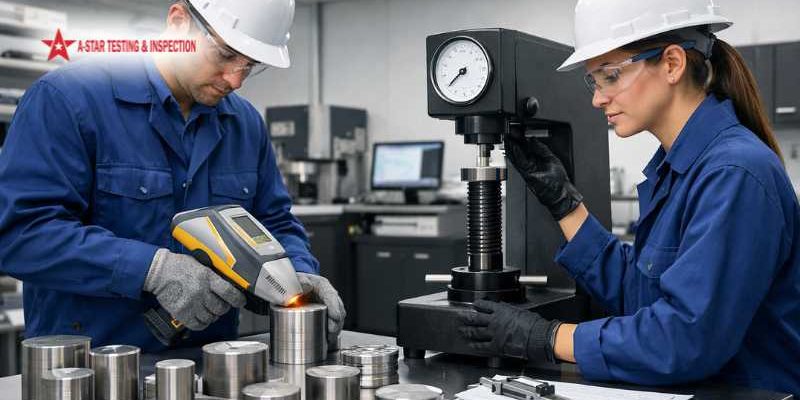
In the contemporary industry, there is no room of error when it comes to material selection. It is either a high-pressure pipeline at a refinery or a beam in the structure of a manufacturing facility, and the safety of the whole operation depends on the integrity of the metal. It is here that Positive Material Identification (PMI) & Hardness Testing Services come in handy.
These services are made by means of chemical verification and mechanical strength analysis in such a way that each of the components, a small bolt and a huge pressure vessel, is just what the engineering specifications require. These are some of the most important NDT solutions offered by A-Star Testing & Inspection to enable the organization to minimize risk and catastrophic equipment failure as well as operational excellence.
Significant Scope Clarification: Our material check and inspection service is purely land-based and topside. We are not offering underwater or subsea material testing services.
What is Positive Material Identification (PMI)?
Positive Material Identification (PMI) is the non-destructive testing (NDT) method that is employed to determine the chemical composition of metals and alloys. A major threat in a globalized supply chain is material mix-up. A stainless steel grade 316 pipe may appear the same as a grade 304 pipe yet the property of their corrosion resistance is far different. PMI testing eradicates this version.
Advanced PMI Testing Methods:
To achieve the greatest degree of accuracy, we use the state-of-the-art technology:
- X-Ray Fluorescence (XRF): This technique determines the elemental composition of a metal using handheld analysers by assessing the emitted fluorescent X-rays of a sample induced by a primary X-ray source.
- Optical Emission Spectrometry (OES): Most projects that involve the detection of lighter elements, such as Carbon, OES offers a more elaborate profile of spectrometry, which is in full compliance with ISO and IACS standards.
Key Applications of PMI Testing
- PMI of Stainless Steel and Alloys: The right amount of chromium and nickel in the corrosive environment.
- Weld Quality Assurance: It refers to the checking that the filler metal employed in a weld is identical to the parent material to avoid galvanic corrosion.
- Oil & Gas and Petrochemicals: Transport systems of volatile fluids, Alloy verification of high stakes.
Understanding Hardness Testing Services
Where PMI is an answer to what a material is composed of, Hardness Testing is an answer to how it will perform. Hardness is the ability of a material to resist localized plastic deformation, e.g. indentation or scratching. The tensile strength and wear resistance of a metal in an industry are directly proportional to the hardness of the metal.
Primary Hardness Testing Methods
Some of the hardness testing procedures that we provide, depending on the material and thickness, are outlined below:
- Rockwell Hardness Testing: It is the most widely used test, which is applied to test both soft and hard metals rapidly.
- Brinell Hardness Testing: This test is ideal when the material has an irregular or coarse-grained structure, e.g., castings and forgings.
- Vickers Hardness Testing: A micro-hardness test that is perfect on very thin materials or minute, localized portions of a weld (the Heat Affected Zone).
The Benefits of Accurate Hardness Measurement
In the absence of periodic hardness testing, materials may get either too brittle (and therefore crack in an instant) or too soft (and therefore wear and deform easily). Our services ensure:
- Material Durability: This is a check to ensure that the heat-treatment processes have resulted in the required strength.
- Failure Prevention: The detection of the weak points in pipes or machines during their initial phases when they may cause structural failures.
- Compliance: Adhering to high-quality standards of ASME and API codes.
The Combined Power of PMI & Hardness Testing
When Hardness Testing Services is performed along with Positive Material Identification (PMI), a 360-degree picture of the integrity of assets is obtained. This two-checks-and-balances procedure is necessary because:
1. Reducing Operational Risk & Downtime
One of the principal causes of industrial downtime is unexpected material failure. Operators can detect wrong alloys or not in the correct hardness level during a turnaround or fabrication stage so that they can replace bad parts before they are commissioned to the service.
2. Strength and Durability Verification
With high-stress equipment, it is not sufficient to know the grade of alloy used but also to determine whether the material has been tempered or hardened properly. The PMI plus hardness measurement is a combination that will guarantee that the component is not only chemically correct but also strong.
3. Comprehensive Quality Control (QC)
In the manufacturing and construction industries, the services serve as a gatekeeper at the end. They make sure that the physical reality of a given product is the same as what the supplier offers in the form of the so-called MTR (Material Test Report).
Industry Applications: Who Needs These Services?
In a variety of industries, our Positive Material Identification (PMI) and Hardness Testing Services are essential:
Oil & Gas and Petrochemical Plants
These environments are always threatened by corrosion and high pressure. PMI guarantees that acidic environments have high-alloy steels, whereas hardness testing guarantees that pipes are able to endure the mechanical stress of the high-volume flow.
Manufacturing and Fabrication Units
Our services are also used in fabrication shops to test incoming raw materials and to test finished products before delivering to the client. This is of particular concern to the fabrication of stainless steel and exotic alloys.
Construction & Engineering Projects
Bridges, high-rise skeletons, or any other structure made of metals have to be made of a particular strength standard. On-site testing is done to ensure that the engineering blueprints are followed when constructing with steel.
Inspection & Testing Techniques: NDT Focus
The fundamental element of our service is Non-Destructive Testing (NDT). This is aimed at offering profound knowledge without affecting the further utilization of the component.
- Complex Material Inspections: We do not just make the checks and pass by them; we offer intricate reports that can be utilized as the Fitness-for-Service (FFS) evaluation.
- Corrosion and Wear Assessment: The test of the surface hardness of an aging piece of equipment is used to determine how long we can expect the piece to last, and then it will require retirement.
- Quality Control Inspection: With our portable systems, we take the lab to your location, where hundreds of tests can be completed in one shift without having to cut the samples.
Compliance, Standards, and Certification
The standards that the service follows determine quality in testing. Our Positive Material Identification (PMI) services and Hardness Testing Services are fully consistent with international standards:
- ISO-Certified Procedures: Making sure of a globally acknowledged standard of accuracy and quality control.
- IACS-Approved Verification: This is necessary in the case of marine and offshore assets, in which the approval of the marine and offshore classification society is obligatory.
- Regulatory Compliance: We assist the Malaysian and international operators to comply with the DOSH and PETRONAS regulations on the safety of assets.
FAQs – Positive Material Identification (PMI) & Hardness Testing Services
Q1: What is PMI testing and why is it significant?
Ans: PMI (Positive Material Identification) refers to the procedure that is used to verify the elemental composition of an alloy. This is essential since any mistake in selecting an inappropriate material in a chemical or high-pressure setting may cause leakages, explosions, or the structure collapses.
Q2: What kind of hardness testing is most popular with on-site projects?
Ans: In case of on-site use, we normally apply Portable Hardness Testing devices (Portable Hardiness Testing equipment e.g., Leeb or UCI testers). These enable us to test large and immovable equipments such as storage tanks and pressure vessels without necessarily transporting them to the laboratory.
Q3: Will it be possible to perform PMI and hardness testing during the operation of the plant?
Ans: Yes. Since they are not destructive and can be transported around, we can frequently conduct Positive Material Identification (PMI) & Hardness Testing Services on live equipment, assuming that the temperatures of the surfaces do not exceed the operating temperature of the equipment in question.
Q4: Do you provide underwater, subsea testing of materials?
Ans: No. We only provide services to surface, topside and industrial material testing. We do not offer subsea inspection on a diving basis or ROV.
Q5: What is the average duration of a PMI test?
Ans: Via modern handheld XRF analyzers, a simple alloy check only takes 5 or 10 seconds per point, which is why in a limited time, a large number of items can be screened.
Conclusion: Partnering for Material Excellence
Positive Material Identification (PMI) & Hardness Testing Services are not only administrative burdens, but the basis of a safe and efficient industrial process. By keeping your metals not only chemically right but also in good mechanical condition, you safeguard your people, your equipment, and not to mention your reputation.
In the world in which material failure may lead to devastating consequences, will you dare to guess what your assets consist of?
Get in touch with A-Star Testing & Inspection to get a quote or to book a consultation appointment when you have a new project of material verification or hardness testing. We can assist you in making sure that the integrity of all the welds, pipes, and plates in your facility is intact.